Author: Aayush Bhardwaj The Law of the Sea works on a tension of structures: round the clock development of coastal State jurisdiction on the one hand, and freedom of the international community on the other. This tension is more carefully controlled in no other provision than in the Principle of Due Regard, emphasized throughout various
Author : Gurleen (BBALLB) The ICFAI University, Dehradun Abstract The Code of Civil Procedure, 1908 forms the backbone of India’s civil justice system, yet its century-old framework struggles to meet the demands of modern, complex, and technology-driven disputes. This article examines the key procedural issues within the CPC—such as excessive formalism, inefficient summons service, cumbersome
Author – Adya Mishra (The ICFAI University, Dehradun) Abstract Section 89 of the Code of Civil Procedure (CPC) marks a pivotal legislative shift towards integrating Alternative Dispute Resolution (ADR), especially mediation, within India’s civil justice framework. This article examines the historical evolution, judicial interpretations, and operationalization of Section 89, highlighting its role in facilitating amicable
Author – Komal Joshi (4th Year, BBALLB) The ICFAI University, Dehradun Co-Author – Dr. Vivek Kumar (Asst. Professor, The ICFAI University, Dehradun Abstract The doctrines of Res Sub Judice and Res Judicata occupy pivotal positions in civil jurisprudence. Both aims to prevent multiplicity of proceedings, avoid conflicting judgments, and uphold judicial economy. Section 10 of
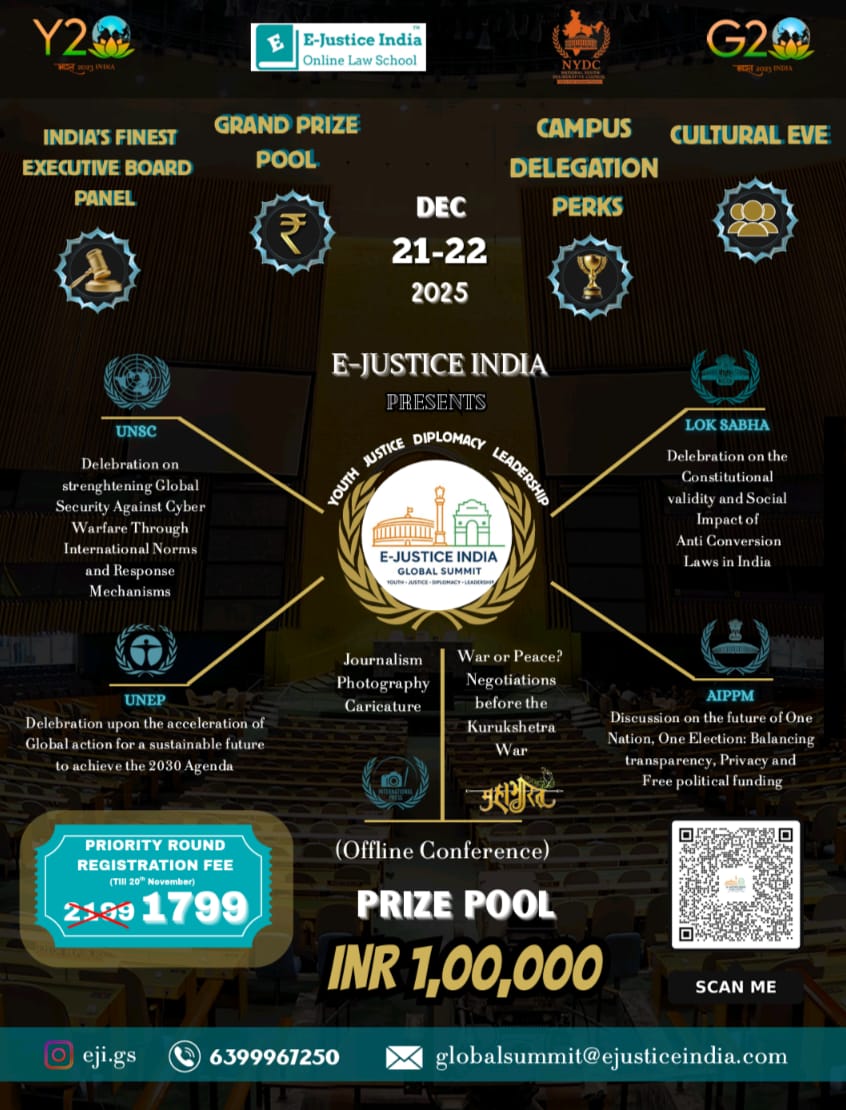
Organized by: E-Justice IndiaVenue: Billabong High International School, Cantt, Kanpur, Uttar PradeshDates: 21st & 22nd December, 2025 About the Event E-Justice India Global Summit – Kanpur Edition 2025 is a two-day national event organized by E-Justice India, one of India’s top-ranked legal education platforms. The Summit aims to bring together dynamic students from schools and
Author : Tewary Aditya Uttpal Introduction The simulation of human intelligence processes by machines, particularly computer systems, is known as artificial intelligence (AI). Learning, thinking, and self-correction are all part of it. Natural language processing (NLP), machine vision, speech recognition, expert systems, and generative tools like ChatGPT and Perplexity are a few examples of AI
The Government of India has appointed Advocate Meesu Sudhir Tomer, Member Executive, Rouse Avenue Court, as Government Pleader before the Hon’ble Delhi High Court. The appointment is being viewed as a recognition of his professional excellence and legal expertise. Article: New Delhi, [11-09-2025] – The Government of India has appointed Advocate Meesu Sudhir Tomer, Member
About the College Nawada Vidhi Mahavidyalaya is a law college in Nawada, Bihar, that was established in 1988. The college is permanently affiliated with Magadh University, Bodhgaya, and recognized by the Bar Council of India. It aims to provide high-standard legal education and has two branches. About the Seminar The seminar will take place in
Author: Advocate Amit Kumar Sharma, Supreme Court of India Introduction The question of whether children of officers of the Central Armed Police Forces (CAPFs) fall within the “creamy layer” of the Other Backward Classes (OBC) category is not merely a matter of administrative categorization. It delves into the core of India’s constitutional vision of substantive
Author(s): Abstract The very spirit of democracy in India rests on the foundational right to freedom of speech and expression, a right enshrined under Article 19(1)(a) of the Indian Constitution. This constitutional guarantee has long been considered a cornerstone of India’s democratic ethos. However, the same Constitution, through Article 19(2), permits the State to impose